

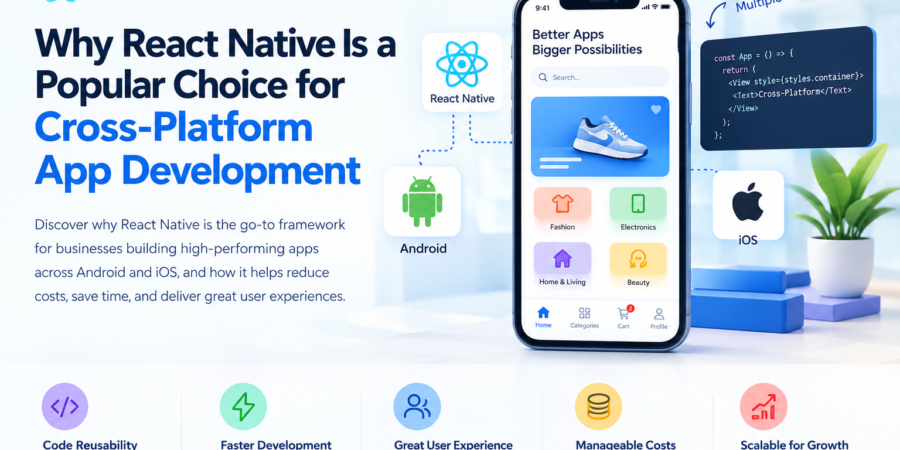
Building a mobile app for both Android and iOS can be challenging when businesses need to manage separate code bases, development timelines, and budgets. Cross-platform development offers another approach by allowing teams to reuse code while creating apps for multiple platforms. Among the available frameworks, React Native has become a popular option for businesses looking for practical and scalable mobile solutions.
React Native has an established developer ecosystem and continues to evolve through regular framework updates. Its ability to share application code across platforms makes it a relevant option for companies planning modern mobile applications.
What Makes React Native Stand Out in Cross-Platform Development?
React Native is an open-source framework that allows developers to build mobile applications using JavaScript and React. It helps teams share much of their application code across Android and iOS while still using native platform capabilities when needed.
For businesses exploring Cross-Platform App Development, this approach can simplify development and make it easier to maintain a consistent experience across devices. However, the amount of reusable code depends on the app’s features, integrations, and platform-specific requirements.
1. One Codebase Can Support Multiple Platforms
One of the biggest advantages of React Native is code reuse. Developers can share much of the app’s business logic, components, and application structure between Android and iOS versions.
This can reduce duplicated work and help teams deliver updates more efficiently. For example, an ecommerce business can use shared code for product listings, shopping carts, and customer profiles while implementing platform-specific functionality where necessary.
Although one codebase does not eliminate every separate task, it can make cross-platform projects easier to manage.
2. A Familiar Technology Stack Helps Development Teams
React Native uses JavaScript and React, making it accessible to developers who already have experience with web development. Teams familiar with these technologies can apply existing knowledge to mobile projects rather than learning an entirely different development approach.
This familiarity can help businesses build teams, maintain application code, and collaborate across web and mobile projects. It can also make react native development services a practical option for startups and established companies that want to extend their digital products to mobile users.
3. Native-Like Experiences Improve User Engagement
Mobile users expect applications to feel responsive and familiar. React Native supports native user interface components and platform integrations, helping developers create experiences that align with Android and iOS conventions.
Developers can build features such as:
- Smooth navigation and interactive interfaces
- Push notifications
- Camera and location access
- Secure login and account management
- Payment integrations
- Device-specific functionality
Performance depends on implementation, application complexity, and the libraries being used. Apps with demanding graphics, extensive background processing, or specialized hardware requirements may need additional native development.
4. Development Costs Can Be Easier to Manage
Building and maintaining separate native applications may require additional development effort. React Native can reduce some duplication by allowing teams to reuse code and share development resources.
However, the Cross-Platform App Development cost depends on the project’s scope, design, integrations, security requirements, testing, and maintenance needs. A simple business app will generally require a different budget from a complex fintech or ecommerce platform.
Businesses should estimate costs based on the features they need rather than assuming that a cross-platform framework automatically makes every project cheaper.
5. Faster Updates and Ongoing Maintenance
Mobile applications need regular updates to fix bugs, improve usability, address security issues, and introduce new features. React Native’s shared codebase can help teams implement common changes across Android and iOS without duplicating every development task.
For example, if a company updates its account settings or product discovery experience, developers may be able to apply much of the same change to both platforms.
Nevertheless, platform-specific code, operating system changes, and third-party dependencies still require separate attention. Regular testing remains essential before releasing updates.
6. A Growing Ecosystem Supports Modern App Requirements
React Native benefits from a broad ecosystem of libraries, tools, and community resources. Its official development roadmap also shows ongoing improvements to developer tooling and the framework itself.
Businesses should evaluate library quality, maintenance activity, compatibility, and security before adding third-party packages to a production application. Choosing reliable dependencies helps reduce technical risks and supports long-term application maintenance.
7. Suitable for Startups and Established Businesses
React Native can support a range of business applications, including ecommerce platforms, booking systems, customer portals, delivery apps, and internal business tools.
Startups may value the ability to launch on multiple platforms while managing limited development resources. Established companies may benefit from shared components, consistent user experiences, and a common development workflow.
The right approach depends on the app’s purpose, expected user base, technical complexity, and long-term product roadmap.
How to Choose the Right React Native Development Services
Selecting a development partner is just as important as choosing a framework. Before hiring a provider, businesses should evaluate the following factors:
- Relevant experience: Review previous mobile applications and projects similar to yours.
- Technical expertise: Check experience with React Native, TypeScript, APIs, databases, and native integrations.
- Security practices: Ask how the team protects user data, manages authentication, and handles sensitive information.
- Testing strategy: Confirm that the team tests across different devices, screen sizes, and operating system versions.
- Cost transparency: Request a breakdown of design, development, testing, deployment, and maintenance expenses.
- Long-term support: Make sure the provider can manage updates, performance improvements, and future feature development.
Professional react native development services should cover more than coding. A reliable partner helps define requirements, choose the right architecture, test the application, and plan for ongoing improvements.
Is React Native the Right Choice for Your Business?
React Native is a strong option when a business wants to reach Android and iOS users while reusing much of its application code. It can support efficient development workflows, consistent interfaces, and manageable maintenance for many types of mobile products.
However, it is not the best solution for every project. Apps that depend heavily on advanced graphics, specialized hardware, or platform-specific capabilities may benefit from native development or a hybrid approach.
Before making a decision, compare your business goals, technical requirements, timeline, and Cross-Platform App Development cost. With the right planning and an experienced development team, React Native can provide a practical foundation for building and growing a cross-platform mobile application.
Source: React Native official documentation and development blog.

Leave a Reply